


Get that buttery, classic melt-in-your-mouth texture you love in this gluten-free shortbread recipe. Whether you bake this homemade shortbread in traditional wedges or use cookie cutters to make fun shapes, it holds its shape beautifully during baking. There is no grittiness, just a soft crunch. I have also included a few flavor variations so that you can enjoy your shortbread plain and simple or with a creative twist.
This post may contain affiliate links. Please read our Disclosure Policy.

❤️ Sandi’s Recipe Summary
The Quick Bite: Get that classic shortbread flavor and texture without grittiness. All you need are 6 simple ingredients. You can make this delicious gluten free shortbread in traditional wedges or use your favorite cookie cutters. This shortbread is great for holidays and gifting. Make a batch in 1 1/2 hours, including chill time.
These are really lovely cookies. So easy that my (no-bake) husband made the dough. They turned out perfectly. Tender, buttery, crisp on edges, everything shortbread should be! Highly recommend.”
Jennifer, Blog comment
Shortbread has always been one of my favorite cookies. Before going gluten-free, I loved Walker’s Shortbread. A few years ago, I noticed they introduced a delicious gluten-free version at the Fancy Food Show in San Francisco. I created my recipe to be a flavor copycat, and have worked hard to eliminate any grittiness from the gluten free flour.
I include my testing notes below if you are curious how I perfected this recipe. This shortbread makes great holiday gifts. If you prefer a slice-and-bake cookie, these Gluten-Free Sables have a similar flavor. You can also try my maple version, Gluten-Free Maple Shortbread.
If you love cookies as much as we do, you will want to check out all of my delicious homemade gluten-free cookie recipes! You may also love this new Gluten-Free Lemon Shortbread recipe.

Testing Notes From My Kitchen
This easy gluten-free shortbread recipe has been a family favorite for years, and it’s a great Walker’s Shortbread copycat recipe. This shortbread turns out buttery and crisp, with the classic melt-in-your-mouth shortbread texture.
I tested a dairy-free version using Earth Balance plant-based butter. Its flavor was close to using real butter, but not 100% the same. It did work well, though; just chill the dough longer because plant-based butter tends to be softer.
I tested three flour blends: King Arthur Measure for Measure, Bob’s 1:1, and my homemade gluten-free all-purpose flour (gum-free), so you know what works reliably. Other flour blends will work, but keep an eye on the shortbread dough texture. Some starchy blends require extra flour. If your dough seems wet, add more flour. If your dough seems dry, add more melted butter. I recommend making your adjustments one tablespoon at a time so you have better control.
I have seen gluten free shortbread recipes that use either white sugar or powdered sugar. I have tested both ways, and honestly, I prefer using a combo to get the right texture. I found that using only powdered sugar does not give shortbread its slight crispiness.

Ingredient Notes and Easy Swaps:
For the full list of ingredients and amounts, please go to the recipe card below.
- Gluten-Free Flour Blend – I tested this recipe using Bob’s Red Mill 1 to 1 and King Arthur Measure for Measure. Other blends will work, but moisture adjustments may be necessary. Read Why Gluten-Free Flour Blends Vary to learn more.
- Binder – If your gluten free flour blend doesn’t contain a binder such as xanthan gum or guar gum, please add 3/4 teaspoon. Learn more about Why Binders are Important in Gluten-Free Baking.
- Butter – I recommend using high-quality European unsalted butter. This butter has a higher fat content, which makes the shortbread have a creamier butter flavor. I tested this recipe with Danish Creamery and Plugra European butter.
- Vanilla Extract – Use pure vanilla extract. Using imitation vanilla will affect the final flavor.
Substitutions:
- To make this recipe dairy-free, use plant-based butter.
- To make this recipe gum-free, use my DIY Gluten-Free Flour Blend. It uses psyllium husk instead of xanthan or guar gum.
How to Make Gluten-Free Shortbread (Step-By-Step)

Step 1: Add your dry ingredients to a large mixing bowl. Whisk to blend.
Step 2: Melt your butter and add the pure vanilla extract. Whisk to mix. Some recommend using room-temperature butter instead of melted butter. I have tested both and couldn’t tell much of a difference.

Step 3: Pour the wet ingredients into the dry and mix into a soft dough.
Step 4: Wrap your dough in plastic wrap and refrigerate for 30 minutes. This has two purposes. First, it gives the rice flour time to soften, which eliminates grittiness. It also firms up the dough so that it holds its shape during baking.
Remove the dough from the refrigerator. The dough should be easy to shape into an oval. If your dough is wetter, add more flour. If your dough is too firm, add more butter.
Preheat your oven to 450º F. Use the regular bake setting and not the convection setting.

Step 5: Place the dough on parchment paper. Press your dough to 1 inch to 1 1/4 inches thick. Use a rolling pin or flat-bottomed glass to flatten the top and smooth it out.
👀 Sandi Says: If you prefer a different shape, use your favorite cookie cutters, or cut the dough into rectangles with a pizza wheel.
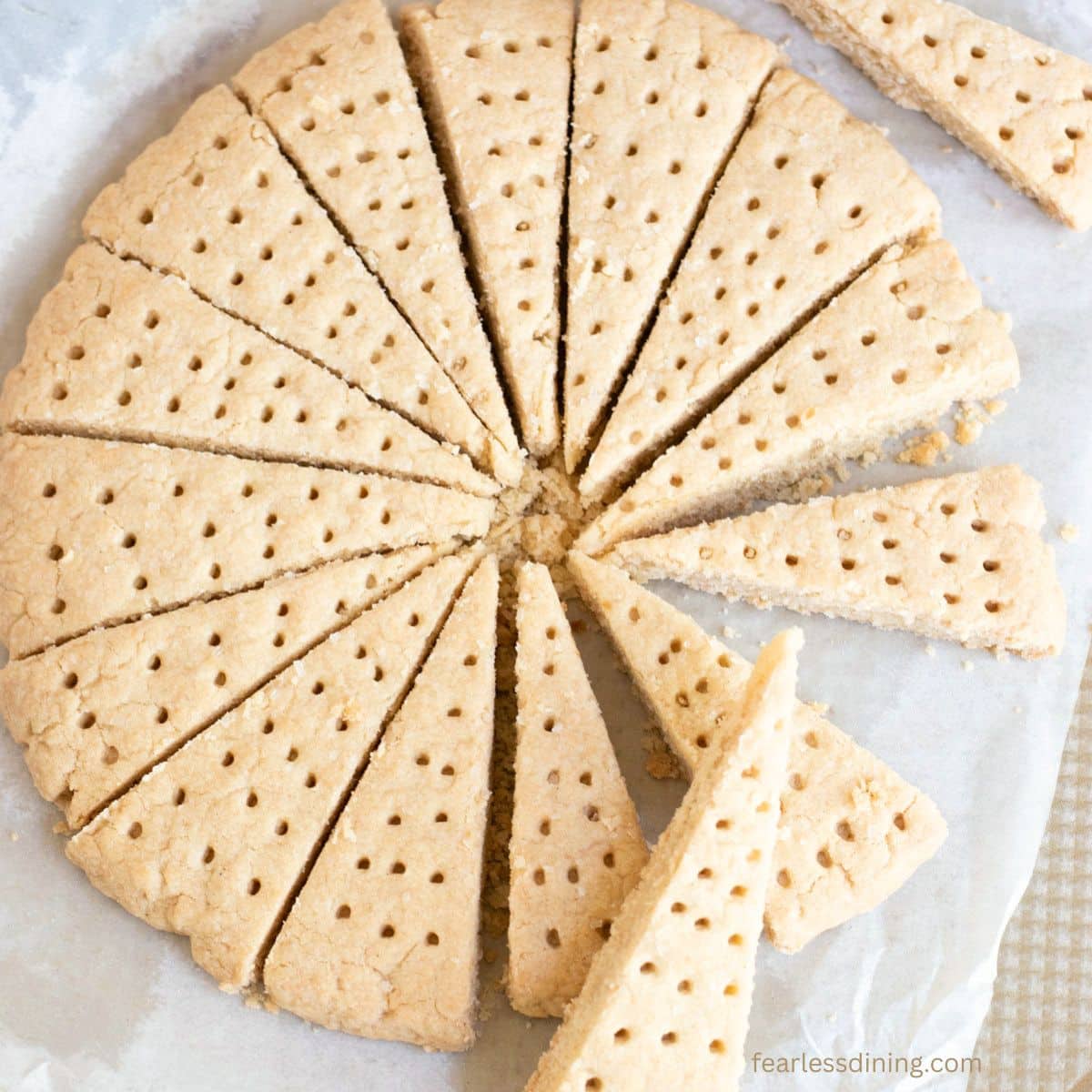
Step 6: Score the dough by cutting it into wedges. Use a big, sharp knife or a pizza cutting wheel. I have more control in keeping the lines straight using the big knife. I find scoring before baking makes cleaner cuts without the shortbread crumbling.

Step 7: Use a shishkabob stick to poke holes. These are decorative but do help your shortbread bake more evenly. If you are short on time, you can skip this step.
Turn the oven down to 300ºF.
Step 8: Optional: Sprinkle with coarse sugar. Slide the parchment paper onto a
Step 9: Bake for 45 to 55 minutes, until the top is golden. The long, low bake helps make this shortbread crispier.
Enjoy the gluten free shortbread plain, or dip/drizzle some melted chocolate over it! Need a holiday-favored version? Gluten Free Pumpkin Spice Shortbread and my Gluten Free Gingerbread Shortbread recipes!
Try these yummy flavor variations:
- Lemon – Add 1 tablespoon of lemon juice and 1 teaspoon of lemon zest. Delicious at a summer tea party!
- Espresso – If you love the coffee flavor, add 1 teaspoon of instant coffee to the dry ingredients! Pair with dark roast coffee.
- Chocolate Chip – Add mini chocolate chips or chocolate shavings to the dough. Enjoy anytime!
- Holiday Special – I love this shortbread mixed with dried cranberries and pistachios! It makes a wonderful cookie for the fall and winter holidays!
Frequently Asked Questions:
Because shortbread has so few ingredients, it is hard to mess it up. The best secret is using high-quality butter. Some very creamy butter brands, like Plugra, use European butter, which works well.
Poking holes in the shortbread helps distribute heat more evenly, allowing the center to bake while the outside edges brown.
I know many like to cut back on sugar. Shortbread has so few ingredients; they work together to taste like real shortbread. I do not think cutting back on sugar is a good idea for this recipe.
Shortbread’s three most common shapes are wedges (made in a circle and cut like bicycle spokes), circles, or rectangles.
If you love European cookies, you will also want to try these Italian Gluten Free Pizzelle Cookies!

More Gluten-Free Cookie Recipes:
I have so many incredible gluten-free cookie recipes on the blog. Here are some of my favorites:
- Gluten-Free Linzer Cookies
- Easy Gluten-Free Vanilla Wafers
- Buttery Gluten-Free Cowboy Cookies
- The Best Gluten-Free Chocolate Chip Cookies
Love This Gluten-Free Shortbread Recipe?
If you made and enjoyed this recipe, I would be incredibly grateful if you could leave a comment below. Please include which flour blend you used. This will help others know this recipe is delicious. Thank you!
Homemade Gluten-Free Shortbread
Ingredients
- 2 cups gluten free flour blend * see note
- ½ cup white sugar
- ⅓ cup powdered sugar
- ¼ teaspoon salt
- 1 teaspoon pure vanilla extract
- 1 cup unsalted European butter * see note
Equipment
- Rolling Pin
Method
- Add 2 cups gluten free flour blend, 1/2 cup white sugar, 1/3 cup powdered sugar, and 1/4 teaspoon salt to a large mixing bowl. Whisk to blend.
- Melt 1 cup unsalted European butter and 1 teaspoon pure vanilla extract. Whisk to mix. Some recommend using room-temperature butter instead of melted butter. I have tested both, and I was not able to tell much of a difference.
- Pour the wet ingredients into the dry and mix into cookie dough
- Wrap your dough in plastic wrap and refrigerate for 30 minutes. Remove the dough from the refrigerator. The dough should be workable so you can shape it into a circle. If your dough is wetter, add more flour. If it is too dry and crumbly, add more melted butter. Every flour blend varies, so adjustments like this is normal.
- Preheat your oven to 450º F. Line a cookie sheet with parchment paper.
- Place the dough on the parchment paper. Press your dough to 1 inch to 1 1/4 inch thickness.
- HINT: Use a rolling pin or flat bottomed glass to make the top flat and smooth.
- Score the dough by cutting it into wedges. Use a big sharp knife or a pizza cutting wheel. I find I have more control in keeping the lines straight using the big knife.
- Use a shishkabob stick to poke holes. These are totally decorative, but do help your shortbread bake more evenly.
- Optional: sprinkle with coarse sugar. Slide the parchment paper onto a cookie sheet.
- Put the shortbread into the oven and turn DOWN the oven temperature to 300º F.
- Bake for 45 to 55 minutes until the top is golden. The long bake on a low temperature is what helps make this shortbread crispier.
- Remove the shortbread and slide the parchment paper off the baking sheet to a cooling rack. The shortbread will crisp as it cools. It is more fragile out of the oven. Wait 15 minutes, then carefully slide the shortbread off the parchment paper onto the cooling rack directly. Do not eat until they are fully cooled.
- Enjoy them plain or dip/drizzle some melted chocolate over them!
Nutrition
Notes
- I have tested this recipe with King Arthur Measure for Measure and Bob’s Red Mill 1:1. That doesn’t mean others won’t work; I just haven’t tested other flours.
- Binder – If your blend doesn’t contain a binder, add 3/4 teaspoon of xanthan gum to hold the shortbread together.
- Butter – You can use vegan butter to make this dairy-free, but note it will not be as creamy or buttery in flavor. I highly recommend using European butter because it has a higher fat content. I have tested the recipe using Danish Creamery and Plugra butter brands.
- These cookies will last for up to 4 days in an airtight container or up to 4 months in the freezer.
- See the recipe post for lots of flavor variations.
Private Notes
Tried this recipe?
Let us know how it was!
I truly hope you enjoy this recipe. I have been testing and creating gluten-free recipes for over 15 years. Creating gluten-free recipes that do not taste gluten-free is my goal for every recipe. Sometimes I only have to test a new recipe a couple of times, and others it takes multiple times. I do this so you get reliable, delicious results every time!

Is a great recipe. I can’t wait to eat it! I usually love Fearless dining recipes. Especially the basic ones like this shortbread.
Hi Carole, I am so glad you loved the recipe. Thank you very much for trying my recipe.
Ccan these be made into a log and then sliced and baked into individual cookies?
Hi Marcy, that works very well for this cookie recipe.
Followed the recipe ingredients to a “T” but used a glass baking dish instead of a baking sheet. Theses did not hold their shape and melted out. They became quite brown (yes, I turned the oven temp down) and I turned off the oven at 35 minutes. Will not make again.
Hi Tamra, I am sorry this recipe didn’t work out for you. I would love to help troubleshoot since so many have great success with this recipe. First, I need to know the flour blend you used. Every brand has a different starch to grain ratio, which affects the moisture level. What was the dough consistency? I don’t bake with glass, but glass does heat very differently than metal. Let me know the flour blend and we can chat further.