


This gluten-free sourdough starter begins with flour and water. As it develops, you can continue feeding it naturally or use an optional gluten-free culture to stabilize activity if fermentation stalls or your kitchen runs cold. The day-by-day schedule below outlines what to expect, how often to feed, and how to recognize normal activity versus signs of contamination.
This post may contain affiliate links. Please read our Disclosure Policy.
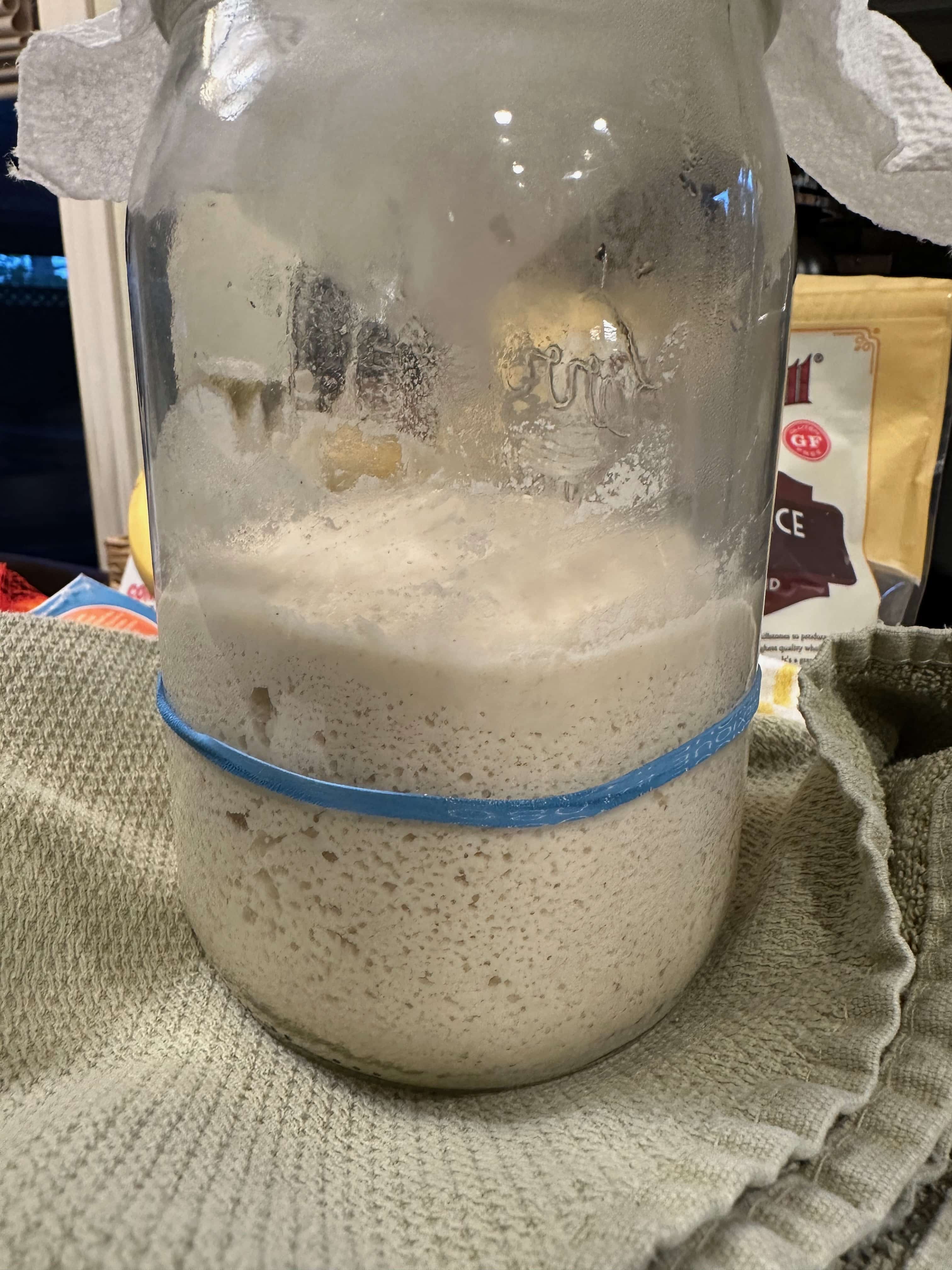
This post on gluten-free sourdough starter focuses solely on the wild yeast starter creation. I walk you through adding flour and water when you have an established starter. The separate sourdough bread recipes cover shaping, hydration, and the bake schedule. You can also see all of my gluten-free sourdough and discard recipes for more ways to use your sourdough starter.
My recipe includes starter options using single-grain flours, gluten-free blends, and the optional GF culture, so you can choose the method that works best for your kitchen conditions and experience level.
Sourdough Starter Instructions:
I share a lot of important tips and recommendations on making your gf sourdough starter. Everything from the best water to use and how to keep your starter warm. Please read the ENTIRE post before you get started.
Day 1:
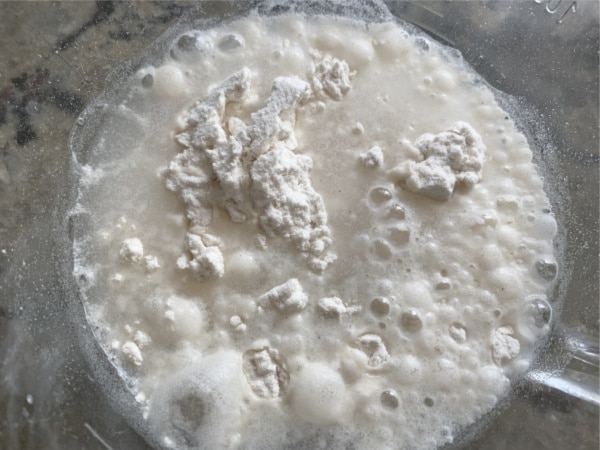
- Mix equal parts of a gluten-free flour blend and water (1:1 feed ratio) in a clean bowl or quart-sized mason jar. I start with 1/4 cup of flour to 1/4 cup of water. You want the starter to have the consistency of a slightly thick pancake batter. Do not use pure starch sources such as tapioca and potato. If you are using the Cultures for Health Gluten-Free Culture, add it to the jar. Mix well.
- Cover loosely with a breathable cloth and keep at 72–79°F for best growth.
- You will feed the starter 2-3 times a day. Later in the day, feed it with 2 tablespoons of flour to 2 tablespoons of water. Mix well.
Day 2:
On day two, feed the starter 1 TBSP of flour to 1 TBSP of water 2-3 times a day. Keep the 1:1 flour-water ratio. Again, be sure to use filtered water and stir the starter well.
Days 3-4:
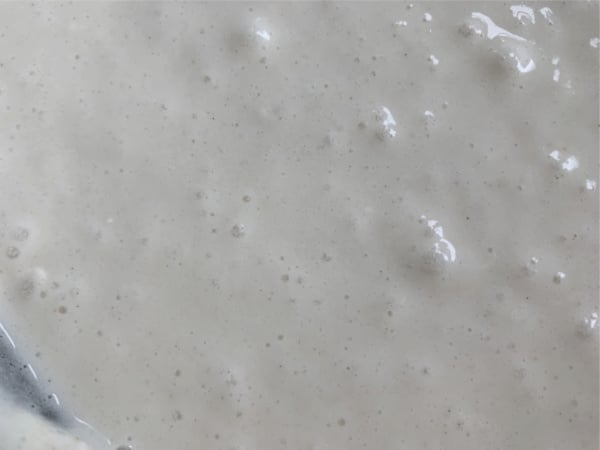
After 3-4 days, your mixture should begin to smell sour and have some bubbles. Keep feeding your starter twice a day until it is full of bubbles and doubles in size within a few hours of feeding it.
Time to discard! As the amount of starter in your jar grows, I recommend discarding some. It is too young to use in discard recipes at this point. The discarded starter can be placed in the trash or in the compost. In the early stages, I discard 2-3 tablespoons each day.
By discarding some of your starter, the remaining starter can continue to strengthen and establish itself with the feeds.
👀 Sandi Says: Do not dump the discard down the drain. It is sticky and can cause a lot of plumbing issues.
Day 5 and Beyond:
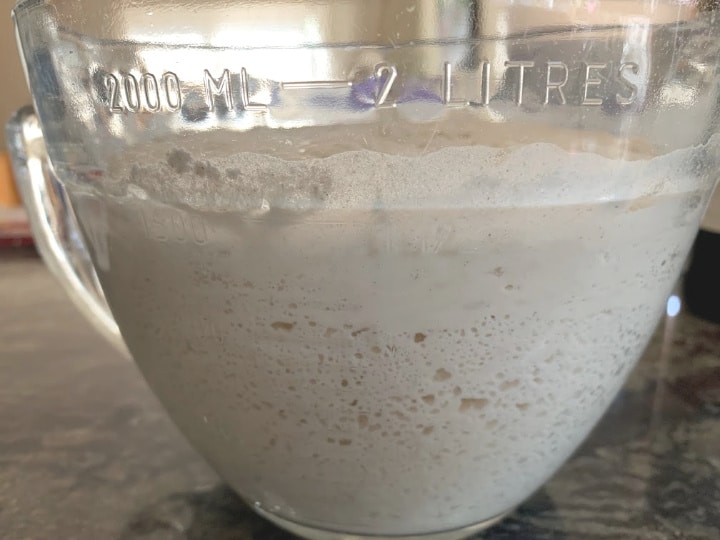
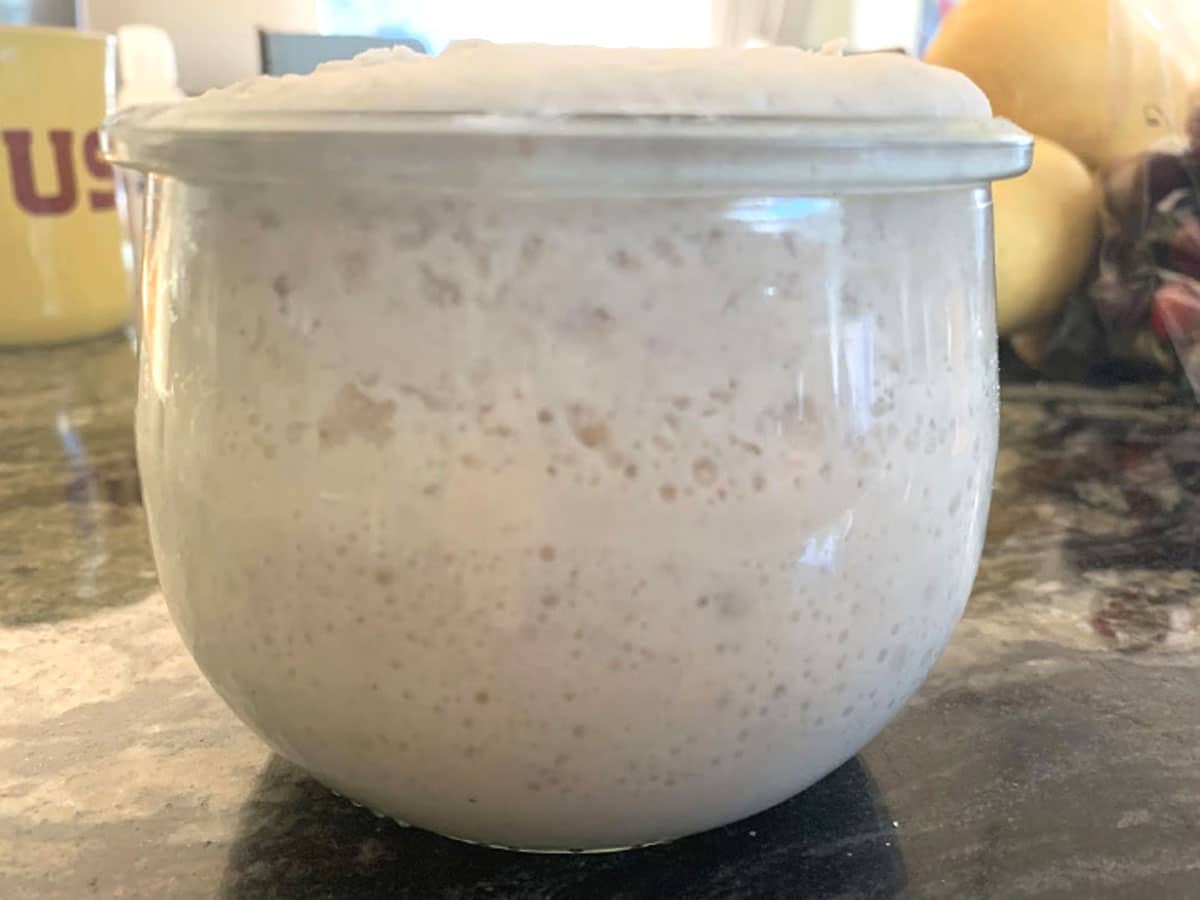
This is what the starter should look like now! Look for lots of bubbles. It should still have the consistency of thick pancake batter. Sometimes it takes a few extra days, so keep repeating the steps of feeding and discarding.
If your starter is not full of bubbles, here are some things to check:
- Check the temperature: How cold is it where you are growing your starter? Yeast needs warm temperatures to activate and grow.
- Are you feeding it often enough?
- Are you using a gluten-free flour blend? Sometimes this can slow things a little because of the starches and xanthan gum.
Start with the right tools; read My Favorite Sourdough Tools for a full list of equipment.
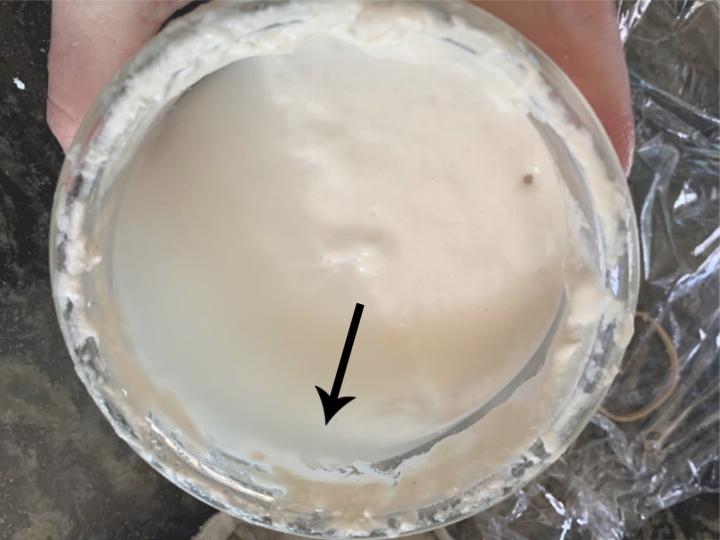
🔑 Sandi says: If you see clear liquid on top of your starter, this is called hooch. This means you need to feed your starter. You will want to drain off that liquid before feeding the starter.
Planning to Make the Starter:
It is important to plan before you begin to make your starter. Decide whether to make your starter with just flour and water, or give it a jump-start using Cultures for Health Gluten-Free Culture. I have made starters using both methods, and I find my readers have a higher success rate with the flour-and-water plus culture.
Email This Recipe To Me!
- I always use purified water when making sourdough or baking with yeast. Chlorine and chemicals in our tap water can kill your yeast and inhibit the rise. To get the best rise, you must use purified water that doesn’t contain these chemicals.
- You need to plan how you want to keep your starter warm, between 72-79ºF. It will not ferment or establish if it is cold.
- Lastly, choose what flour you will use to grow your starter. Years ago, I used a gluten-free flour blend, but over the years of making starters, I’ve found that a single-grain flour is best. I have seen folks grow successful starters with brown rice flour, millet flour, buckwheat flour, and other types. My favorite is brown rice flour.
Keeping Your Starter Warm:
When getting your starter going, it must be kept warm enough for the bacteria to grow. I have found several ways to keep the sourdough starter warm.
Many of my readers keep their sourdough starter in the microwave or oven with the light turned on and the door closed. The light generates enough heat to keep the starter warm. The two cons of this method are that you can burn out the light, and if someone forgets your starter is in the oven, someone may preheat the oven and ruin your starter.
I used an old Euro Cuisine Yogurt Maker base that my mother-in-law gave me. Plug in the base and place two folded dish towels on top to help prevent it from getting too hot. I place the jar on top of the towels.
They also make sourdough warming mats that easily fit a quart-sized mason jar. This is better than the option I used above because you can set the temperature.
How do I know if the starter has gone bad?
If you don’t see many bubbles or if something seems off, smell your starter and take a close look at it. Discard it immediately if you notice:
- rotten/chemical odor
- pink or orange streaks
- fuzzy growth
How To Store Your Gluten-Free Sourdough Starter:
The starter should be kept on the counter, warm for another week or two, feeding and discarding until it is well established. I do not recommend storing your starter in the fridge until it is at least 3 weeks old and established.
If you want to continue using your starter, keep it in the refrigerator. The refrigerator slows the fermentation process, and it puts your starter to sleep so you don’t have to feed it as often.
A good way to tell if your starter is ready to refrigerate is whether it doubles within 2-4 hours of feeding; it is ready to refrigerate.
- Do not store your sourdough starter in a metal container. Store in a glass or ceramic container. I store mine in a quart-sized mason jar. (These are my favorites because they have plastic lids!)
- Time to Store the Discard! You will want to continue to discard by taking out some of the discard before feeding the starter. The amount of discard depends on how much starter you have. If my jar has 1/2 cup total starter, I would discard 3-4 TBSP. (I keep the discard in a separate container to use it in gluten free discard recipes.) Feed the starter before putting it in the fridge.
- If the starter is on the younger side, feed it in the refrigerator every 4-5 days. Once your starter is well established, it can go into the refrigerator. As the sourdough starter ages, you can feed it less often, once every 1 1/2 to 2 weeks. I feed mine by adding 2 TBSP of flour to 2 TBSP of purified water. Stir it well so the flour is incorporated. If your blend is starchy, you can use 3 tablespoons of water.
- Cover it with the lid and refrigerate.
When you plan to bake with your starter, remove it from the refrigerator the night before, discard some, feed it, and let it come to room temperature. Keep it covered with a clean, damp kitchen towel.
What to make with the discard:
Want more ways to use up your gluten-free sourdough discard? Don’t miss my full list of tested gluten-free discard recipes!
You can use the discard to make these Gluten-Free Discard Crackers or these Gluten-Free Sourdough Discard Biscuits if you choose to discard. We also love these Gluten-Free Sourdough Discard Muffins.
We named one of our past starters “Freddie,” and it became a running family joke about who remembered to feed him. You don’t need to name yours, but if it helps you feel connected to the process, go for it.
Frequently Asked Questions:
My opinion has changed over time. I no longer use a gluten-free flour blend. I use only brown rice flour to make and feed my starters. It is cheaper than a 1:1 blend and activates and remains active much better because there is no starch or gum to slow fermentation.
Yes, you can switch flour types. Fermentation may slow for a day or two, depending on whether you use a blend or single-grain flour, but it will pick up again!
The liquid that forms on top of your sourdough starter is known as “hooch.” When you see hooch in your starter, it indicates the sourdough needs to be fed; the development of hooch is normal and not a cause for concern.
Drain off the hooch before you feed the sourdough starter. You may notice the hooch smells like alcohol, which is also expected.
Yes, you can freeze the sourdough starter. If you freeze the starter, you will not have to feed it. When you are ready to bake the bread, you must give the sourdough starter a week before the dough is active again. You must begin the feeding process once you remove it from the freezer.
Freezing the starter is an excellent idea if you don’t have the time and effort to keep feeding it. I recommend freezing.
Don’t forget to check out the next step…making the sourdough bread!
When I first interviewed Sadie at Bread Srsly, she was so generous to share an older version of her famous sourdough recipe with me to share with my readers. I have streamlined Sadie’s original recipe and tested a few different gluten free flours and blends to make it easier for you to recreate this recipe.
If you want to try Sadie’s original recipe given to me, you can use 1/4 cup of millet flour or 1/4 cup of sorghum flour. (Check out Rachel’s comment in my Gluten-Free Sourdough post to see her comments on how she uses the millet flour!)
Gluten-Free Sourdough Recipes To Try:
- This sourdough starter, aka levain, is used in my Gluten-Free Crescent Rolls recipe.
- Gluten-Free Sourdough Discard Scones – Perfect for using up discard!
- Don’t forget to check out the next step…making the Gluten-Free Sourdough Bread! This recipe makes a sandwich-style loaf using 1:1 gluten-free flour blends!
- My new favorite is this rustic Gluten Free Cranberry Walnut Sourdough Bread or Gluten Free Whole Grain Sourdough Bread.
- Use this gluten-free sourdough starter to make this homemade Gluten-Free Sourdough Boule
Love This Recipe?
I still have readers message me years later about the success they’ve had after finally getting their starter active. If that ends up being you, I would genuinely appreciate hearing it. Drop a comment below, and let me know how it turned out!
How to Make a Gluten Free Sourdough Starter




Ingredients
- ¼ cup gluten free flour * see note
- ½ cup purified water * see note
Instructions
- It is important to read my entire post before making this gluten-free sourdough starter. This is one recipe where it is IMPORTANT to read my whole recipe post, not just this recipe card. I have a lot of experience with sourdough, and the tips I share are valuable to your success.
Day 1
- Mix equal parts of a gluten-free flour blend and water (1:1) in a clean bowl or quart-sized mason jar. I start with 1/4 cup of flour to 1/4 cup of water. You want the starter to have the consistency of a slightly thick pancake batter. Do not use pure starch sources such as tapioca and potato. If you are using the Cultures for Health Gluten-Free Culture, add it to the jar. Mix well.
- NOTE: I highly recommend using filtered or bottled water. Chlorine and chemicals will kill the beneficial bacteria you are trying to grow.
- You will feed the starter 2-3 times a day. Later in the day, feed it with 2 tablespoons of flour to 2 tablespoons of water. Mix well. Cover loosely with a breathable cloth and keep at 72–79°F for best growth. (See Notes)
Day 2
- On day two, feed the starter 1 TBSP of flour to 1 TBSP of water 2-3 times a day. Keep the 1:1 flour-water ratio. Again, be sure to use filtered water and stir the starter well.
Day 3-4
- After 3-4 days, your mixture should begin to smell sour and have some bubbles. Keep feeding your starter twice a day until it is full of bubbles and doubles in size within a few hours of feeding it.
- Time to discard! As the amount of starter in your jar grows, I recommend discarding some. It is too young to use in discard recipes at this point. The discarded starter can be placed in the trash or in the compost. In the early stages, I discard 2-3 tablespoons each day.
- Do not dump the discard down the drain. It is sticky and can cause a lot of plumbing issues.
- If your bowl or jar starts to get full, feel free to discard some of the starter. In Sadie's original recipe, she didn't write about discarding any of her starter. I do take out some disard because it helps your bacteria become stronger.
Day 5 and Beyond
- This is what the starter should look like now! Look for lots of bubbles. It should still have the consistency of thick pancake batter. Sometimes it takes a few extra days, so keep repeating the steps of feeding and discarding.
- Refer back to my post to troubleshoot any steps, or if you do not see lots of bubbles.
Notes
- I have used sorghum, brown rice, millet flour, and gluten-free flour blends successfully to make a starter. I prefer brown rice flour because it is a lot less expensive than a flour blend.
- I recommend considering getting the Cultures For Health Gluten-Free Culture to jump-start your starter.
- I found brown rice flour works the best, and it is less expensive to use compared to a gluten-free flour blend.
- In order to give your natural yeast a chance, I highly recommend using purified water. Chlorine in tap water can kill your yeast, not growing your starter.
- I include very detailed instructions for storing your sourdough starter in my article. Please refer back to that because it has a lot of important information.
- I include a very detailed troubleshooting section in my article. If your starter is having some trouble, please refer to the Recipe FAQ in the article.
Email This Recipe To Me!
SPECIAL NOTE
Please know that every gluten free flour blend has a different starch to grain ratio. If you use a blend I didn’t test, my rule of thumb is to add more flour if your dough or batter is wet and add more liquid if the dough or batter is too dry!
Nutrition
Nutrition Disclaimer
Nutritional information is an estimate provided to you as a courtesy. You should calculate the actual nutritional information with the products and brands you are using with your preferred nutritional calculator.
I truly hope you enjoy this recipe. I have been testing and creating gluten-free recipes for over 15 years. Creating gluten-free recipes that do not taste gluten-free is my goal for every recipe. Sometimes I only have to test a new recipe a couple of times, and others it takes multiple times. I do this so you get reliable, delicious results every time!

Day 3, minimal bubbling, it looks & feels like a pudding, not what i expected of a GF starter. Can I add more water, or start over. Used King Arthur GF flour. Thanks
Hi Wanda, I am happy to troubleshoot. 1. What temperature is the area you are keeping your starter? 2. Starches in a 1:1 can slow things down. I really recommend using brown rice flour (individually, not in a blend). 3. How often are you feeding your starter and what is the consistency?
Thank you for all of this. I’ve been successful in a typical sourdough starter, but now I have people asking for gluten free, so I’m going to give it a try. Is it ok to start the starter with Bob Mills 1 to 1 gluten free blend and then convert over to rice flour to get it more active? At what point is that a good time to do? Thank you for your help?
Hi Rachel, The starches and xanthan gum in the 1:1 may slow things down as far as the starter taking off. I have used a 1:1, but I am curious. Why use an expensive 1:1 when brown rice flour is easier, faster, and costs a lot less money? I haven’t switched the flour on an active starter, so I am not sure on that question.
I am on day 5 of the starter. I have bubbles!!!! How long do I continue to feed it 1:1? When is it ready to bake with. I don’t in the whole instructions where it tells me that
Hi Jane, That is so exciting!! I would wait and continue to feed and discard until it is more established. How bubbly is your starter?
It looks like the picture that you have for day 5. I have a 32 oz mason jar that is 1/2 full, how much should I discard?
Hi Jane, I would discard 3-4 tablespoons and add it to the compost. Usually a starter should be more established (a couple of weeks) before using discard. Keep feeding it and if it looks like mine, you should be able to bake something with the starter.
Hi Sandy, Darla again. I ordered my gluten-free sourdough starter that you recommended along with the equipment to make the sourdough bread. This is day five; my starter looks nothing like your picture and has very few bubbles and has not doubled once. I followed your instructions to a T. I have a background in science and biology so I know my way around a lab, following instructions, having proper equipment and accurate measurements.
I do smell a slightly sour odor and see a few bubbles before feeding and when I stir. I have a total of one cup starter so I did a discard. Do I need to be patient? And yes, I kept it in a dry warm place that ranged from 74 to 78°
Hi Darla, the 74 to 78 is a bit cool to get a new starter going. It is a good sign you have a few bubbles. You may consider putting it in the oven with just the light for warmth to speed it up. (Don’t turn on the oven…the light will give the necessary warmth.)
Should the sour dough starter smell sour after 4 or 5 days? And should I use starter or discard as bread making? I seen different folks using discard and it confused me a little. And if starter is doubled in 5 to 7 days it’s okay to bake? Or do you have to wait two to three weeks? I love all your recipes you share❤️❤️Thank you
Hi Donna, it should smell sour. Do you see lots of bubbles and activity? For the bread, you use the starter. I would wait at least a full week, maybe longer depending on how active it is. The older it is, it will work better because the bacteria will be stronger.
Thank you so much, you are very helpful I new to this and appreciate what you’re doing thanks again.
I am glad to help. How did your sourdough starter turn out?
Sandi, thank you for your recipe and all your pages of tips and instructions! I just successfully made my very first loaf of gf sourdough bread! (It was DELICIOUS) I used the ‘Cultures for Health’ to begin my starter and used organic rice flour to feed it. I used King Arthur’s Measure for Measure gf flour blend to make the dough / bread. I will continue feeding with the same rice flour and will continue baking bread with the same King Arthur flour blend. I have a number of questions, but they all relate to the extra discard and/or starter:
1) Just to make sure I understand, I don’t need to purchase another ‘Cultures for Health’ starter every time I want to make a new loaf of gf sourdough bread, correct? I’m assuming I can just use some of the (massive amount of) discard I immediately stored in the freezer. If this is not correct, then disregard the below questions.
2) I’m a little confused about feeding the starter because the ‘Cultures for Health’ instructions (which I followed to the T) had me feeding it with ½ cup flour and ½ cup water. Then, with every feeding, it told me to discard down to ½ cup, and then add the new ½ cup flour and ½ cup water. …I noticed you only have people feed with 1 Tbsp flour and 1 Tbsp water. I have waaaaaay too much discard in my freezer (due to feeding with ½ cup flour and water every single feeding!). Here’s my question: once I remove a discard from the freezer, can I just feed it the 1 Tbsp flour / 1 Tbsp water like you suggest? And just discard every now and then?
3) Once I remove a discard from the freezer, how do you recommend thawing it? And would you recommend beginning to feed it as soon as it’s completely thawed?
4) You said it takes a week for the starter to become active again. Do you mean it will take a week of feeding the starter before it’s ready to start making another loaf of bread, OR do you mean it will take a week of feeding before I’ll need to CONTINUE feeding for the standard 3 – 5 days?
5) Some of my discard is from day 1 of beginning the starter. Some of it is from the very end of the process right before the starter was ready to go into a loaf of bread / dough. So, in my understanding, all my discards are at different points in the fermentation process. My question is: will this affect how long (how many days) I’ll need to feed it for once removing it from the freezer? I would assume that the discard from the very beginning of the starter process would take a lot longer to be ready to bake with, as opposed to the discard from the very end of the starter process (when it was really starting to bubble, etc.).
I am so glad you loved this recipe. Let me respond to all of your questions. You don’t need to purchase another starter packet from Cultures for Health. You continue to feed your starter to keep it going. I use 1/4 cup of flour to water…I am not sure your starter is usable this early. Usually you don’t use the discard until it is more established. You can definitely feed it 1 TBSP, but it may not be enough. Better to feed it 2 TSBP. Also, if you are not using it often, you can keep it in the refrigerator, which slows the starter down so you only need to feed it 3x a week (at first) but a it gets older and more established, you can feed it every 1-2 weeks. I wouldn’t use the discard in your freezer. I have never stored it there, but your starter is probably too young if you just started it. I am not sure where you saw it takes a week for a starter to become active. You need to remove it from the refrigerator and let it warm, feed it, and let it get bubbly. Depending on the temperature in your house, this is more a few hours.
Ahhh…so glad I asked. I was a bit overwhelmed by how much information there was about how to successfully make a gf sourdough loaf of bread, I decided I would focus on that and just toss all the discard in the freezer….including the very last portion of my starter. 🙁 I never put anything into the fridge; only freezer. So I probably do need to purchase another starter packet from Cultures for Health. …I first tried this without the starter packet, and just the brown rice flour and water, per your instructions. At the time, I thought it wasn’t working because by day 5 I had no bubbles – nothing. But even with the Cultures for Health packet it actually took 7 full days to get the starter to the point where I could bake bread (in their instructions they say 5 – 7 days). I live in FL where our air conditioning is always on. It says 77 degrees but I think it feels colder than that…to me AND my starter! Hmm…maybe I’ll try the original way (just brown rice flour + water) and turn my temp up to 80 and give it a good week, maybe even two before I decide that it’s not working. I was hesitant to keep it in the oven with the light on because when I open the oven door it feels VERY warm…is there a certain temperature that would be too hot that it could kill your starter??
It is definitely a lot. Yeast definitely needs a warm environment to be active. I suspect it is fine to move your starter to the counter…see how it does so you don’t have to keep the oven light on any longer. Just feed it and see how it does.
Hi Sandi, I’m going to use the sour dough starter you used. Is this a powder or a liquid? Do you add brown rice and water to the starter? Also, when do you switch over from brown rice? I will be using King Arthur 1:1 GF flour.
Thank you!
Suzanne Charles
Hi Suzanne, The Cultures for Health is a powder, or granulated. Follow the directions that comes with it for the first few days.
Hi! I am on Day 3. I used brown rice flour and filtered water. I followed your recipe to a T, except, used dough container, rather than glass jar/bowl? I live in south Florida, so kept in my kitchen bay window, no direct sunlight. My kitchen isn’t exactly warm? We have the AC blowing so my home is definitely at a comfortable 75 degrees! Should I move it closer to the stove or oven?? Towel attached to top with rubber band. It has slight bubbles, no hootch, smells fine, but definitely hasn’t started to “grow”?? It still looks like pancake batter. Is it ok? Do I continue to feed it 3 times a day with a 1:1 ratio??
Hi Meghna, If you are starting to see bubbles and you don’t smell an off smell, it is fine. My guess it is a little slower given the air conditioning. I would continue to feed it 3x a day until it is getting pretty bubbly. You can discard some so the container doesn’t get too full. I wouldn’t use the discard in a recipe because it isn’t established yet.
Thanks so much Sandi! I have never tried to make Sourdough before so I am completely new at this! It’s been 2 more days so now starting Day 5 and still nothing!! It looks the same as day 3. I feed it 3 times a day with Brown Rice flour and filtered water. It’s now started to gain a little hootch that I pour off every time I feed it, but it smells and looks fine, like thick pancake batter, but little to no bubbles and no “growth”/expansion or whatever it’s called! It sits in my kitchen window sill with no direct sunlight, covered with a cheesecloth in a 4qt restaurant grade plastic dough container. So plenty of space to grow!
Hi Meghna, I am worried it isn’t growing, and I think it is too cold if you are running the air conditioning. Can you put it in the oven with an oven light on to keep it warmer?
I am on day 3. Do I still feed it 1 TBSP flour and water days 3-5?
Hi Pam, Please give me a bit more info so I can help. What does your starter look like, how are you keeping it warm, and what flour or blend are you using to feed it? Did you use Cultures from Health or are you starting it from scratch?